
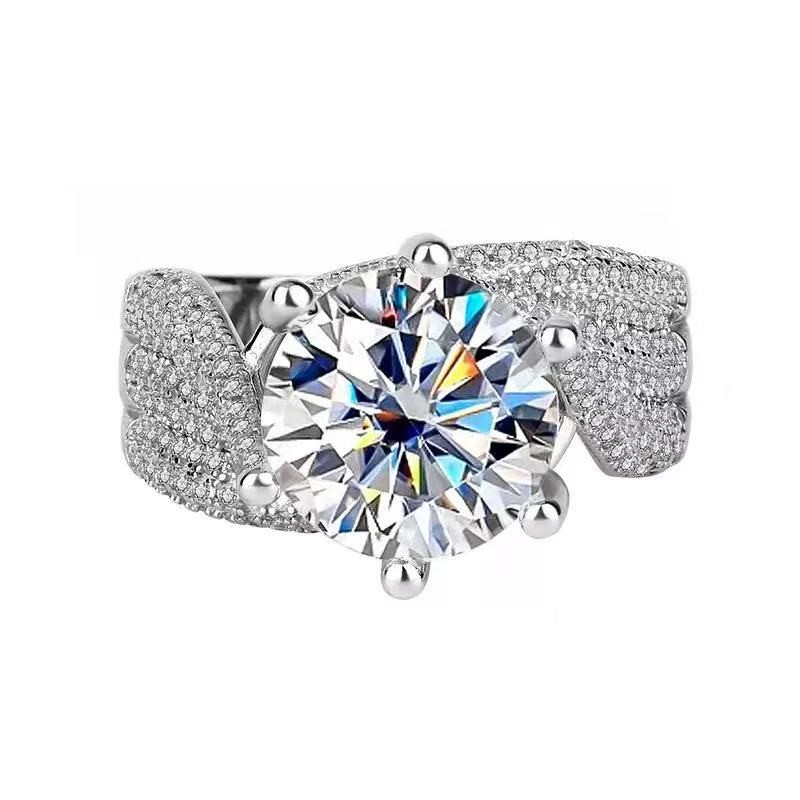
Moissanite vs Diamond vs Lab Grown Diamond vs CZ: The Complete Wholesale Comparison
Direct answer: Moissanite is a silicon carbide gemstone with roughly 2.4× the fire (dispersion) of diamond, at a fraction of the price. Lab-grown diamonds are chemically and physically identical to natural diamonds but cost 60–90% less. CZ (cubic zirconia) is the cheapest simulant but scratches easily and lacks brilliance over time. For wholesale jewelry buyers, moissanite set in 925 sterling silver offers the best value-to-brilliance ratio — which is why it is our factory’s best-selling wholesale category, with 5,000+ in-stock styles and MOQ from just 1 piece.
Quick Comparison Table
| Property | Moissanite | Natural Diamond | Lab-Grown Diamond | CZ (Cubic Zirconia) |
|---|---|---|---|---|
| Chemical composition | Silicon carbide (SiC) | Pure carbon | Pure carbon | Zirconium dioxide |
| Hardness (Mohs) | 9.25 | 10 | 10 | 8 – 8.5 |
| Refractive index | 2.65 | 2.42 | 2.42 | 2.15 – 2.18 |
| Dispersion (fire) | 0.104 | 0.044 | 0.044 | 0.060 |
| Brilliance | Very high (more fire) | High | High | Moderate, dulls with wear |
| Relative price | Low | Very high | 1/3 – 1/10 of natural | Extremely low |
| Certification | GRA (moissanite) | GIA / IGI / HRD | IGI / GIA / HRD | None |
| Everyday durability | Excellent | Excellent | Excellent | Poor (scratches) |
| Resale value | Minimal | Retains value | Minimal | None |
| Best use in wholesale | Fashion, bridal & daily jewelry | High-end market | Bridal & engagement | Costume jewelry |
Is moissanite a real diamond?
No. Moissanite is silicon carbide (SiC), a gemstone first discovered in a meteor crater in 1893 and now grown in laboratories. It is a diamond simulant with its own identity — not a fake diamond in the same category as CZ. Under a loupe, moissanite shows double refraction, which diamond does not. If your customers ask “is it a real diamond?”, the honest and correct answer is: it is a moissanite, a distinct gemstone with more fire than diamond.
Which is more brilliant: moissanite or diamond?
In terms of fire (the rainbow flashes of light), moissanite wins: its dispersion is 0.104 versus 0.044 for diamond — roughly 2.4× more fire. In terms of white brilliance, both are outstanding, and most people cannot tell them apart without a tester. This makes moissanite especially popular for bridal and fashion rings where “sparkle” sells. Every moissanite piece from our factory ships with a GRA appraisal certificate so your customers know exactly what they are buying.
Is moissanite as hard as diamond?
No, but close. Moissanite is 9.25 on the Mohs scale; diamond is 10. In practice, 9.25 is hard enough for everyday wear — harder than sapphire and ruby (9), and far above CZ (8–8.5). Our factory has been producing moissanite jewelry for 10+ years, and we 100% inspect every piece before shipment to ensure stones are securely set and damage-free.
Moissanite vs lab grown diamond: which is better for wholesale buyers?
This depends on your target market:
- Lab-grown diamonds are chemically identical to natural diamonds (same hardness 10, same optics). They are the right choice if your customers specifically ask for “diamond” and you want IGI/GIA certification. Expect a higher price point — roughly 1/3 to 1/10 of natural diamond — and a higher retail ticket.
- Moissanite delivers comparable sparkle at a much lower cost. For fashion lines, tennis bracelets, daily-wear rings and entry-level bridal, moissanite in S925 gives you a compelling price-performance story: our MOQ is 1 piece for in-stock styles, samples take 3–5 working days, and bulk orders ship in 15–20 working days.
A common wholesale strategy is to carry both: lab-grown diamond for the premium bridal segment, moissanite for volume fashion lines. We offer both, plus OEM/ODM customization — send us a photo, sketch or 3D file and we will quote MOQ, price and sample timing If a premium bridal line is on your roadmap, our step-by-step guide to starting with lab-grown diamonds covers certification, MOQ and pricing.
What is CZ, and why is it so cheap?
CZ (cubic zirconia) is a synthetic zirconium dioxide — a true diamond simulant with no diamond properties. It is cheap to produce, which is why it dominates costume jewelry. The downsides are real: it scratches over time (Mohs 8–8.5), loses polish, and its brilliance fades, so it needs replacement sooner. If your line is premium fashion or bridal, moissanite is the better long-term value — the stone keeps its fire for years and every piece carries a GRA certificate.
Which stone should I choose for my jewelry line?
Use this decision rule:
- Customer asks for “diamond” and wants certification → lab-grown diamond with IGI report.
- Customer wants maximum sparkle at the best price → moissanite in 925 sterling silver.
- Budget costume line, low price is everything → CZ, but expect shorter product life and returns.
- Mixed portfolio → carry moissanite + lab-grown diamond; let price tiers guide buyers.
From our factory to your store
Jovelira is a moissanite and sterling silver jewelry manufacturer in Haifeng (Meilong), Guangdong, China — a 1,115㎡ facility with 50 skilled craftsmen covering CAD design, casting, stone setting, polishing and QC in-house. We serve wholesale buyers, brands and retailers with OEM/ODM, private label and MOQ from 1 piece.
- Browse the wholesale collection: S925 Moissanite Jewelry
- Example styles: Moissanite Engagement Ring · Halo Moissanite Pendant · Classic Tennis Bracelet
- Certificates & quality: About Our Factory
- OEM/ODM services: Wholesale Services
Wholesale pricing is available on request — message us on WhatsApp or email amy123lsj@gmail.com. We reply within 24 hours.
New here? Read our wholesale supplier checklist before ordering.
Leave a Reply